
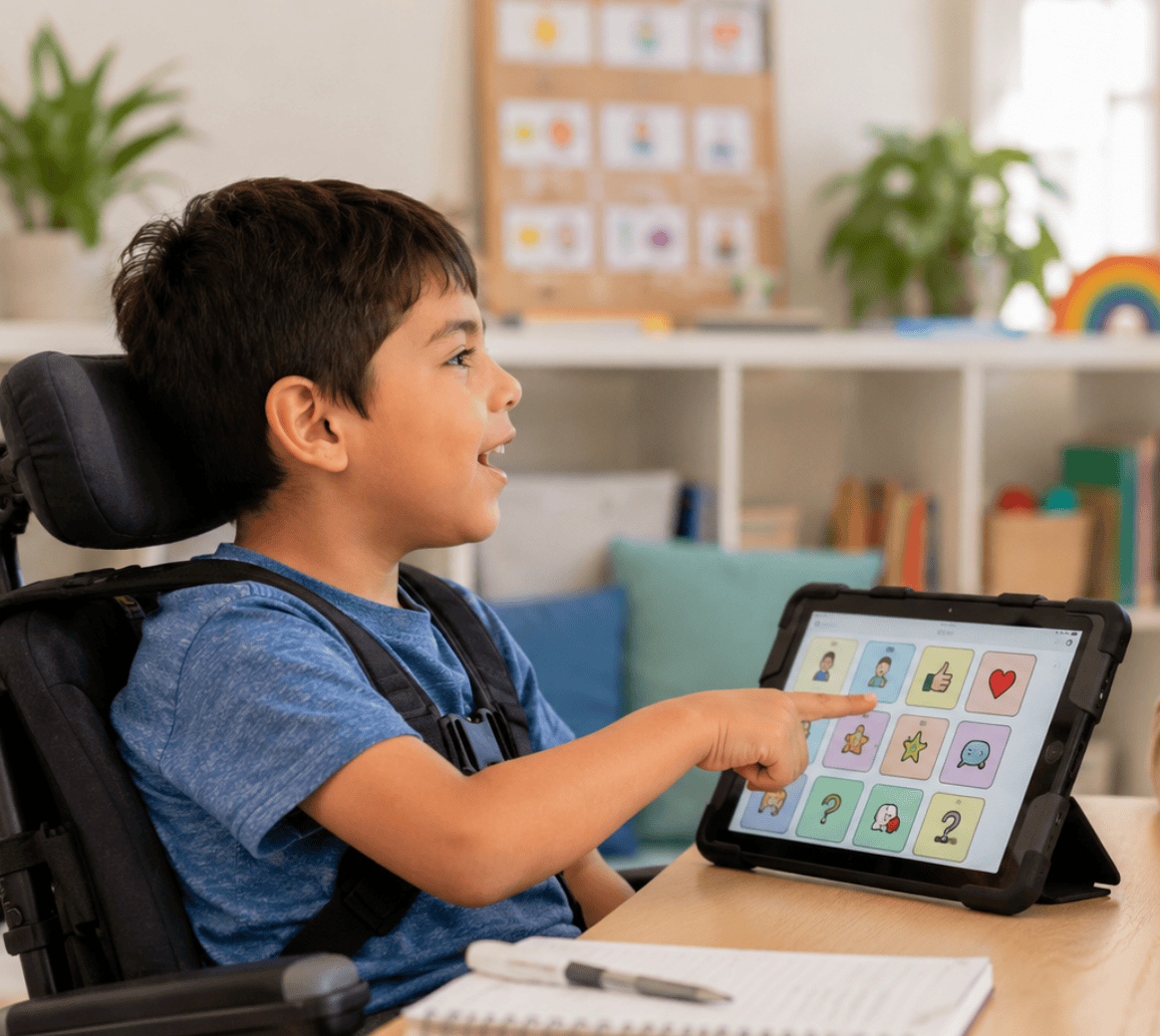



October is International AAC Awareness Month. The observance began in 2007 and is now recognized around the world to increase awareness of augmentative and alternative communication and the many ways people communicate. ISAAC’s 2026 theme is “AAC in Everyday Life: Today, Tomorrow, and Beyond.” ISAAC
Here’s a question we’d like to change:
“Can they talk?”
Instead, let’s ask:
“How do they communicate?”
Because communication is so much bigger than speech.
AAC Is More Than an iPad
AAC—augmentative and alternative communication—can include:
- Gestures
- Facial expressions
- Sign language
- Writing
- Drawing
- Picture boards
- Communication books
- Letter boards
- Speech-generating devices
- Tablet-based communication systems
- Eye gaze
- A combination of communication methods
Some people use AAC all day, every day.
Others use it only in certain situations.
Some people use AAC alongside speech.
And some people may use different communication methods at different points in their lives.
AAC Isn’t Just for Kids
AAC is often associated with pediatrics, but AAC can be appropriate across the lifespan.
A child with limited verbal communication may use AAC at school and home.
A teenager may use it to participate socially.
An adult with a neurological condition may use AAC after losing the ability to communicate effectively through speech.
Someone recovering from a stroke may use AAC temporarily while speech and language skills recover.
AAC can be a lifelong communication system—or it can be a bridge.
Communication Shouldn’t Have Office Hours
Here’s where we want to get creative.
Imagine your communication device being available only during speech therapy.
You couldn’t use it at dinner.
Or at school.
Or when you’re joking with your sibling.
Or when you’re upset.
Or when you see something amazing at the grocery store.
That wouldn’t make much sense.
AAC belongs in everyday life.
Communication partners can help by:
- Keeping AAC accessible
- Modeling language on the device
- Giving adequate wait time
- Responding to all communication attempts
- Presuming competence
- Making communication part of everyday routines
- Allowing the person to choose what they want to talk about
AAC Is About More Than Requesting
AAC isn’t just:
“I want cookie.”
“I want juice.”
“I want toy.”
People who use AAC deserve opportunities to:
Tell jokes.
Complain.
Ask questions.
Tell stories.
Make choices.
Say “no.”
Talk about their interests.
Express emotions.
Build relationships.
Be silly.
Have opinions.
Communication is about having a voice in your own life.
How iRehab Services Can Help
Our speech-language pathologists work with individuals and families to support functional communication and AAC use.
We can help with:
- Identifying communication needs
- Building functional communication
- AAC implementation
- Caregiver education
- Communication partner training
- Language development
- Carryover across environments
- Supporting communication in everyday activities
And because iRehab Services offers in-home, clinic, community, and telehealth services, we can work toward communication goals where they actually need to happen.
📞 248.252.6064
📧 marcia@irehabservices.com
Every voice matters. Every communication attempt matters. And everyone deserves a way to say what they want to say.









leave a comment!
Comments